APPLES IN HEAD TIDE · PANEL II
Status note: The Apples in Head Tide exhibit's physical installation at the Head Tide Store, 45 Head Tide Road, Alna, is in preparation. Opening date to be announced — these pages are live in advance of the physical exhibit and will remain as its permanent online companion.
The Northern Spy & the USDA Watercolors
Among the apples grown in the Sheepscot Valley, the Northern Spy held pride of place — and the artifacts in this collection prove it.
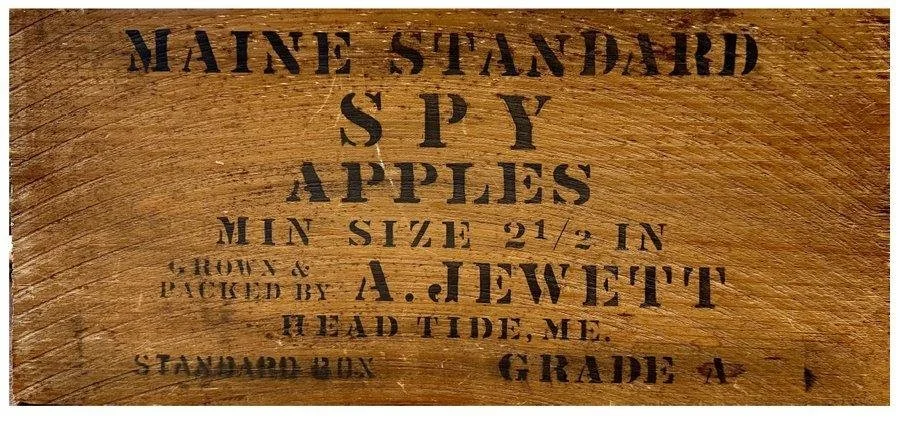
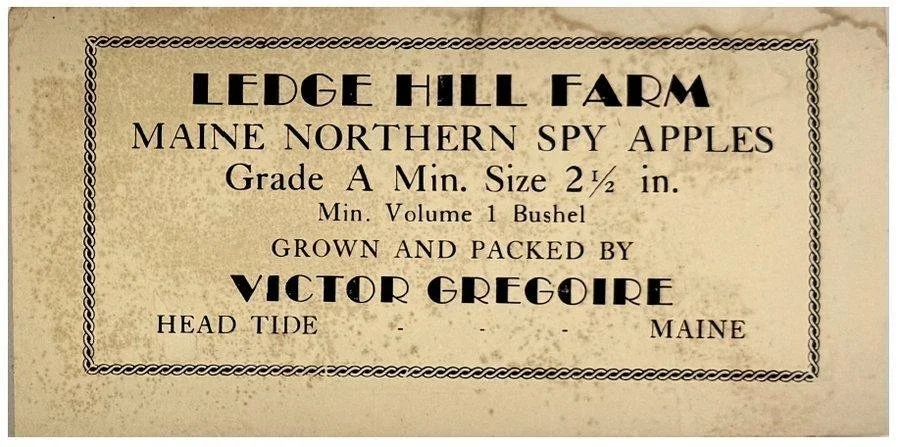
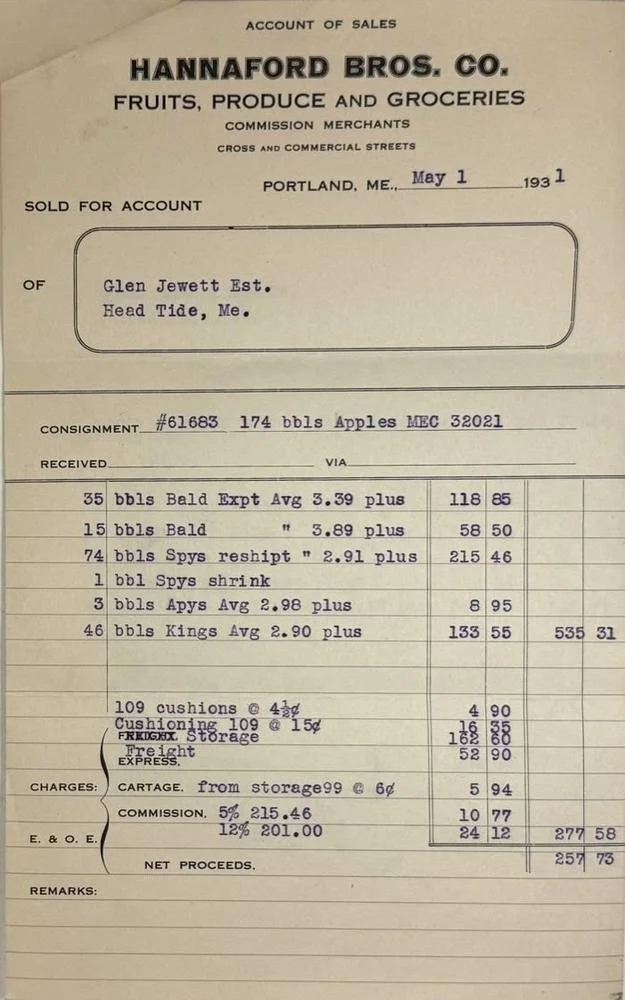
The A. Jewett crate end is stamped "SPY"; the Ledge Hill Farm label specifies "Maine Northern Spy Apples"; and the Hannaford Bros. commission statement itemizes Spys as the largest single barrel lot consigned out of Head Tide. According to John Bunker, who has spent a lifetime identifying and preserving Maine's heritage apple varieties, the Northern Spy is an all-purpose variety, well-balanced, crisp and juicy, that does everything well: good fresh eating, an excellent pie, and exceptional keeping qualities. Maine orchardists prized it especially for those last two qualities: the Northern Spy could carry a family through the long winter, and its flavor only improved with cold storage. As UMaine pomologist Dr. Renae Moran has noted, this was the era before McIntosh became Maine's predominant variety — the Northern Spy, which ripened late and had outstanding storage and shipping potential, was a natural choice for growers sending fruit to distant markets.
One of the most famous of all American apples, the Northern Spy originated as a chance seedling in East Bloomfield, New York around 1800. It was commercially introduced around 1840 and listed as a "variety of promise" by the American Pomological Society in 1852. It remains a renowned Maine favorite to this day.

Northern Spy. One of approximately 7,500 watercolor paintings in the USDA Pomological Watercolor Collection. Source: USDA National Agricultural Library, search.nal.usda.gov. Public domain. The Northern Spy was not the only prized variety grown on the hillsides above Head Tide. The Hannaford Bros. statement also lists barrels of Tompkins King — a large, handsome, aromatic apple sometimes called "the King of the Apple Orchard." Where the Spy was the workhorse, the King was the showpiece: a bold, richly flavored fruit with yellow-tinged, crisp flesh, prized both for fresh eating and baking. Like the Spy, the King originated in New York and was widely planted across New England in the 19th century. Both varieties appear in the USDA Pomological Watercolor Collection, and both were staples of the Maine apple trade during the period documented in this display.
[The Hannaford Bros. statement itemizes both Spys and Kings by name; we do not yet have a source confirming which other varieties were grown in Head Tide specifically, though Baldwins and Greenings also appear on the statement.]

Tompkins King — "the King of the Apple Orchard." From the USDA Pomological Watercolor Collection. Public domain.
The watercolor paintings of the Northern Spy, Tompkins King, and other apple varieties included in this display are from the USDA Pomological Watercolor Collection, one of the most remarkable archives in American agricultural history. Between 1886 and 1942, the USDA commissioned around five dozen artists to create some 7,500 watercolor botanical illustrations of fruit and nut cultivars. The archive spans the years in which American agriculture greatly expanded the range of fruits grown commercially — photography was not yet in widespread use as a documentary medium, so the government relied on artists to produce technically accurate drawings for its publications. About one-third of the artists were women, and working as a government illustrator was one of the few professional artists' jobs open to women at a time when formal art training was only beginning to be available to them. The entire collection is now digitized and freely available through the USDA National Agricultural Library, and all images are in the public domain.
[The Northern Spy's origin and varietal characteristics are attributed to John Bunker (Out on a Limb Apples, Palermo, Maine) and to the American Pomological Society's 1852 listing. The pre-McIntosh observation is from Dr. Renae Moran, Professor of Pomology, UMaine Extension (personal communication, April 2026). The Tompkins King description draws on general pomological sources; we would welcome a Head Tide–specific account of King cultivation from anyone with family or local knowledge. Baldwins, Greenings, and Tolman Sweets also appear in the Jewett Store collection documents but are not treated in this panel.]
Sources: A. Jewett crate end and Ledge Hill Farm / Victor Gregoire bushel label, Jewett Store collection; Hannaford Bros. Co. commission statement (May 24, 1933, Alice Jewett, Head Tide); John Bunker, Out on a Limb Apples (OutonaLimbApples.com); Dr. Renae Moran, UMaine Extension (personal communication, April 16, 2026); American Pomological Society (1852 listing); USDA Pomological Watercolor Collection, National Agricultural Library (search.nal.usda.gov).