APPLES IN HEAD TIDE · PANEL III
Status note: The Apples in Head Tide exhibit's physical installation at the Head Tide Store, 45 Head Tide Road, Alna, is in preparation. Opening date to be announced — these pages are live in advance of the physical exhibit and will remain as its permanent online companion.
The Railway and the Apple Trade
The WW&F Railway — the narrow-gauge "two-footer" that wound through the Sheepscot Valley from 1895 to 1933 — was the artery that connected Head Tide's orchards to the wider market.
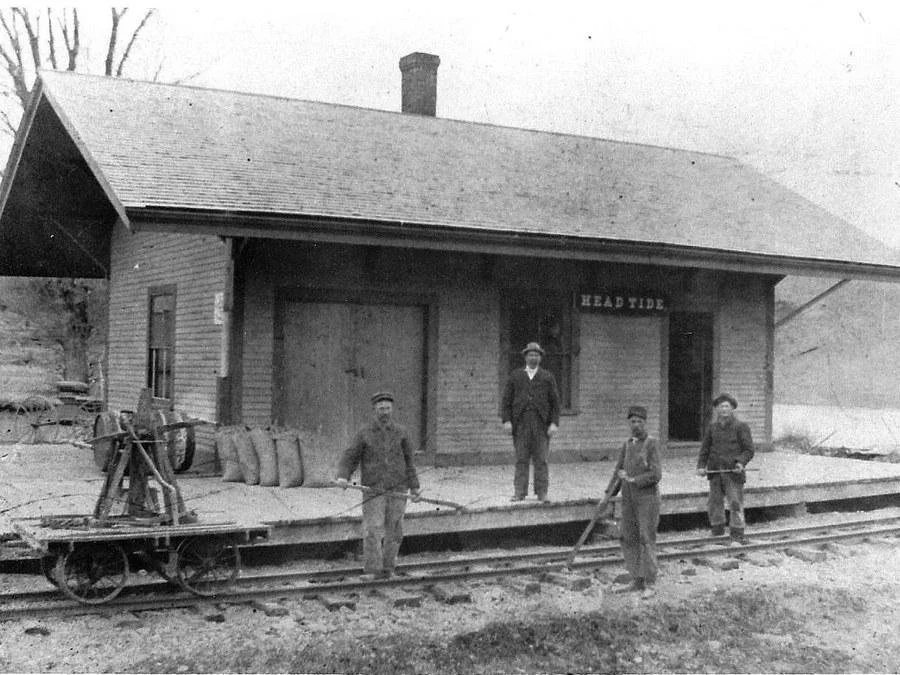
The Head Tide station on the Wiscasset, Waterville & Farmington Railway. The narrow-gauge station building, the platform, and the "HEAD TIDE" sign above the agent's window are all visible; four men stand on the platform with a hand-cart. The original "HEAD TIDE" station sign is on display at the Head Tide Store on loan from the WW&F Railway Museum. From the Jewett Store collection.
The railway had an agent's station at Head Tide with two southbound spurs — loading sidings where crates and barrels of apples could be transferred onto the narrow-gauge cars for the journey down the valley to Wiscasset, where the Maine Central Railroad offered connections to Portland, Boston, and beyond.
[The station layout is documented in the WW&F Railway's records (milepost 9.1, agent's station, two southbound spurs). That apples were among the freight loaded here is our inference from the Jewett Store collection; we are seeking a photograph showing apple or produce loading at Head Tide station specifically.]
The bills of lading in the exhibit confirm the connection in action: Alice B. Jewett, signing for the Estate of Glen A. Jewett, consigned 175 barrels of apples over the WW&F in November 1929; the following year, in November 1930, Lon Jewett shipped a full carload of bulk apples on the Maine Central. Head Tide's orchards were plugged into a distribution network that reached from the narrow-gauge siding at milepost 9.1 to the commission merchants of Portland and, from there, as far as New York Harbor.
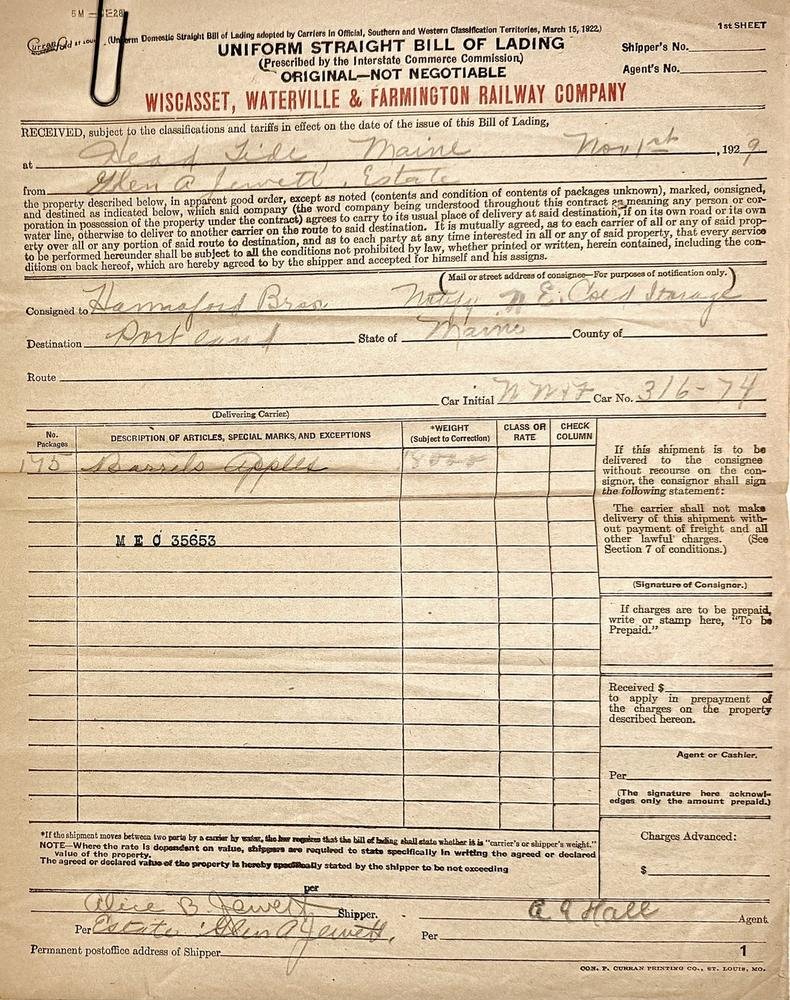
WW&F Railway bill of lading, November 1, 1929. Alice B. Jewett, signing for the Estate of Glen A. Jewett, consigned 175 barrels of apples to Hannaford Bros. at Portland, with delivery to N.E. Cold Storage. The notation "M.E.C. 35653" tracks the onward shipment from Wiscasset, where freight transferred from the WW&F's narrow gauge to standard gauge for delivery into the Maine Central system. From the Town of Alna archives.
[The middle digit of the barrel count on the WW&F bill is partially obscured by handwriting; it reads as either a 7 or a 9 (175 or 195 barrels). We use 175 here.]
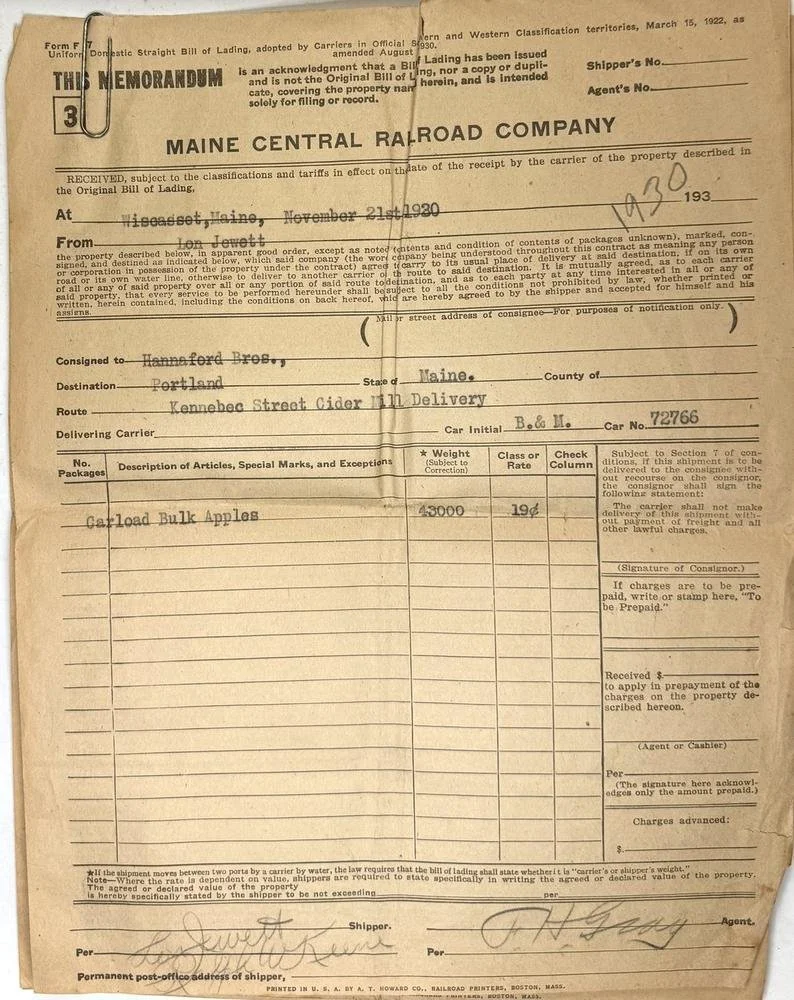
Maine Central Railroad bill of lading, November 21, 1930. Lon Jewett shipped a carload of bulk apples (43,000 lbs) to Hannaford Bros.'s Kennebec Street Cider Mill in Portland. Bulk rather than barreled shipment and a cider-mill destination suggest these were utility-grade fruit, sound but not fancy, bought by weight for pressing. From the Town of Alna archives.
John Bunker, speaking at Alna Center on an October evening in 2017 — an evening that began with a ride from Sheepscot station on the restored WW&F — described how narrow gauge railways like the WW&F opened the interior of Maine to commerce that would otherwise have been impossible, giving small valley farms access to regional markets for the first time. Apple picking season ends with late varieties like the Northern Spy — meaning the last and most valuable apples of the season were coming off the trees just as autumn freight traffic on the WW&F was at its heaviest.
The WW&F hauled potatoes, lumber, and poultry along with other general freight and passengers. Apples were part of that mix too, moving from valley orchards toward coastal markets. When the railway closed in 1933 — a victim of the Depression and competition from trucks and automobiles — Head Tide lost its direct connection to those markets, and the commercial orchards on the hillsides above the village gradually fell into disuse.
The same technological current had local participants. Neal Jewett (1879–1935) — younger brother of Lon and Glen Jewett, the sons of John Allen Jewett who ran the Head Tide store and post office in succession — ran a bicycle shop in Head Tide in his early years and later sold Pierce-Arrow automobiles in upstate New York. Photographs in the Alna town archives show Neal at the wheel of his 1930s-era Pierce-Arrow on return visits to the village. The fuller arc of his career, and its quiet symmetry with the end of the WW&F, will be developed in a future display devoted to the Jewett family.
[The WW&F operating dates (1895–1933) and freight categories are per the WW&F Railway Museum. The claim that orchards "fell into disuse" after railway closure is a widely shared local understanding but we have not yet identified a documentary source tying orcharding decline specifically to the loss of rail service; Todd Little-Siebold (Professor of History, Director of the Maine Apple Lab, College of the Atlantic) may be able to confirm or refine this. The distinction between road infrastructure and motor-vehicle proliferation is worth noting: rural Maine roads in and around Alna remained largely unimproved well into the 1950s and 60s, so the displacement of the WW&F did not come from improved roads but from the rising tide of trucks and automobiles that, despite the unimproved roads, were rapidly proliferating on the back of mass production and parts standardization.]
[Neal Jewett's place in the family tree (younger brother of Lon and Glen, sons of John Allen Jewett and Harriet Pearson), the Pierce-Arrow connection, and the existence of period photographs in the Alna town archives are all confirmed. Still to be documented in the future Jewett-family display: the specific city or region in upstate New York where Neal lived and worked, and his exact capacity in the Pierce-Arrow business. The Head Tide bicycle shop is believed to have been located at "the long house" adjacent to the village dam, opposite the mill and across the road from the Jewett Store; this is easily confirmable from local records.]
Sources: Wiscasset, Waterville & Farmington Railway Museum (wwfry.org); WW&F Railway article (Wikipedia); WW&F Railway bill of lading, November 1, 1929 (Estate of Glen A. Jewett, Alice B. Jewett, 175 barrels, to Hannaford Bros., Portland, with delivery to N.E. Cold Storage); Maine Central Railroad bill of lading, 21 November 1930 (Lon Jewett, carload of bulk apples, 43,000 lbs, to Hannaford Bros. Kennebec Street Cider Mill, Portland); Head Tide station photograph, Jewett Store collection; "HEAD TIDE" station sign, on loan from the WW&F Railway Museum; John Bunker, talk at Alna Center, October 2017. Neal Jewett biographical details (per family memory and the Alna town photographic archives), pending fuller verification in the future Jewett-family display.