APPLES IN HEAD TIDE · PANEL V
Status note: The Apples in Head Tide exhibit's physical installation at the Head Tide Store, 45 Head Tide Road, Alna, is in preparation. Opening date to be announced — these pages are live in advance of the physical exhibit and will remain as its permanent online companion.
From Orchard to Market: Packing, Grading, and Shipping
Moving apples from the hillside orchards in and around Head Tide to a distant market took hands, baskets, boxes, barrels, and two railroads. Two bills of lading in our collection show the Jewetts shipping at commercial scale in consecutive seasons.
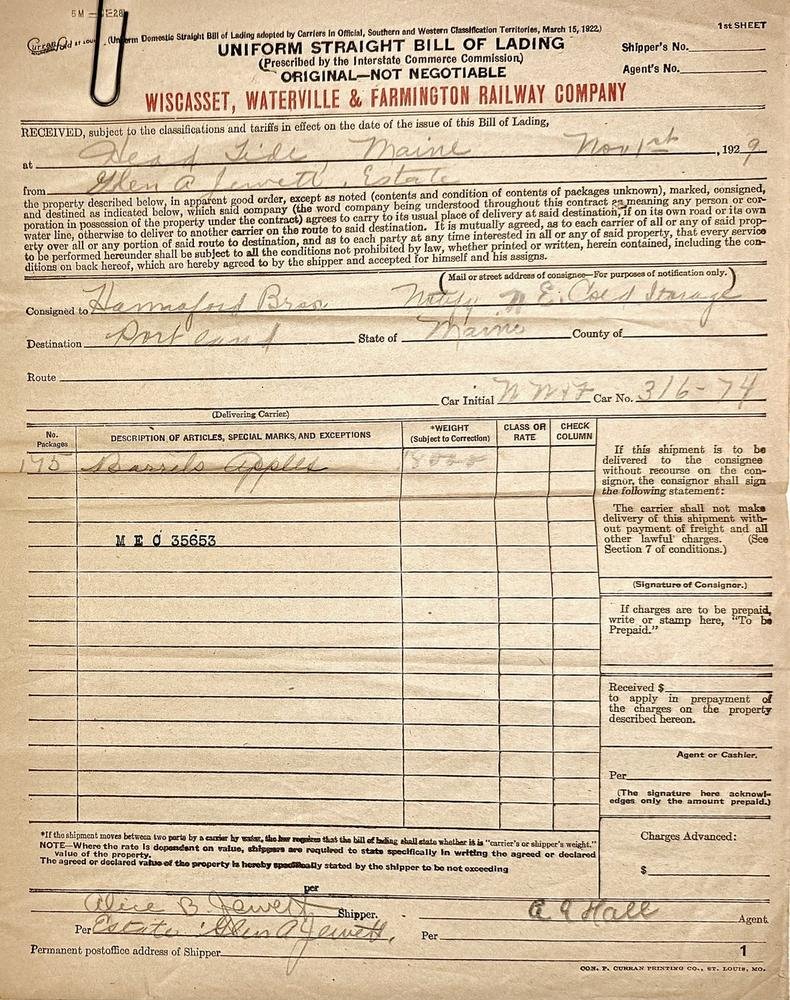
WW&F Railway bill of lading, November 1, 1929. Alice B. Jewett, signing for the Estate of Glen A. Jewett, consigned 175 barrels of apples over the narrow-gauge WW&F to Hannaford Bros. in Portland, with delivery to N.E. Cold Storage. From the Town of Alna archives.
On November 1, 1929, Alice B. Jewett, signing for the Estate of Glen A. Jewett, consigned 175 barrels of apples over the WW&F Railroad — the narrow-gauge line that ran through Head Tide from 1895 to 1933 — to Hannaford Bros. in Portland with delivery to N.E. Cold Storage.
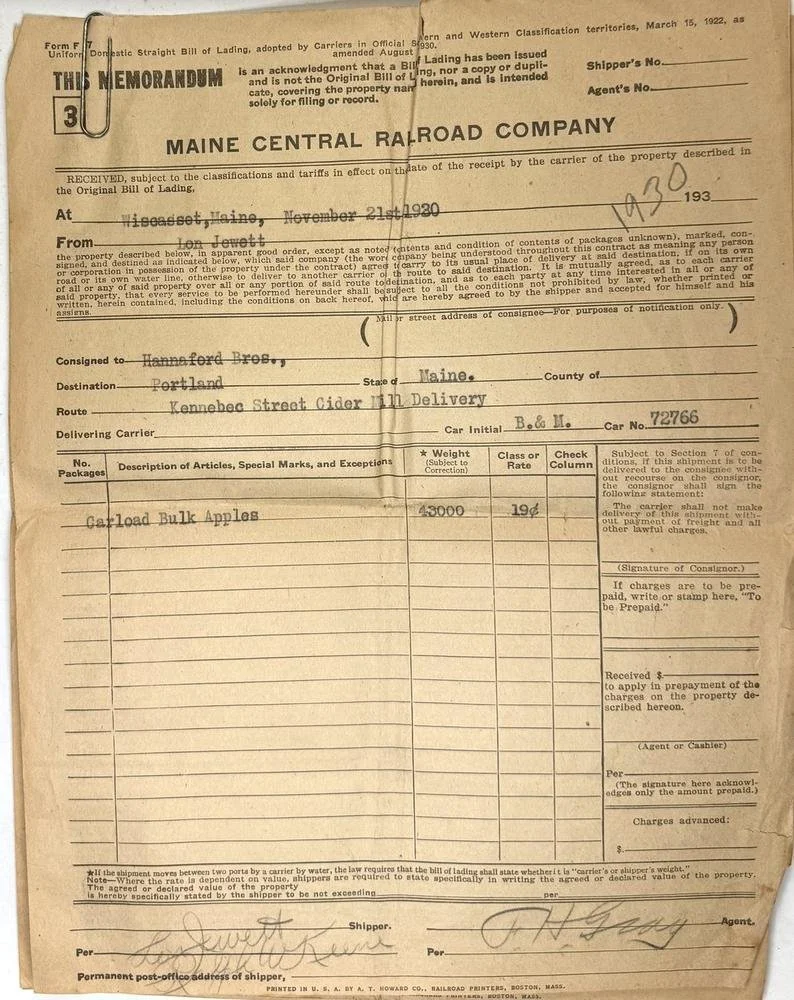
Maine Central Railroad bill of lading, November 21, 1930. Lon Jewett shipped a carload of bulk apples (43,000 lbs) to Hannaford Bros.'s Kennebec Street Cider Mill in Portland. From the Town of Alna archives.
A year later, on November 21, 1930, Lon Jewett shipped a carload of bulk apples on the Maine Central Railroad to Hannaford Bros. Kennebec Street Cider Mill in Portland. Bulk (rather than barreled) shipment and a cider-mill destination suggest these were utility-grade fruit — sound but not fancy — bought by weight for pressing.
[The cider-mill detail is documented on the bill; the grade inference is ours.]
Not every load rode out in barrels. A wooden crate end in our collection — stamped "MAINE STANDARD / SPY / APPLES / MIN SIZE 2½ IN / GROWN & PACKED BY A. JEWETT / HEAD TIDE, ME. / STANDARD BOX / GRADE A" — records the other way a Jewett apple left town: in a rigid wooden box of regulated dimensions, carrying a specific variety (Northern Spy), a minimum fruit size (2½ inches), and a formal grade (Grade A).
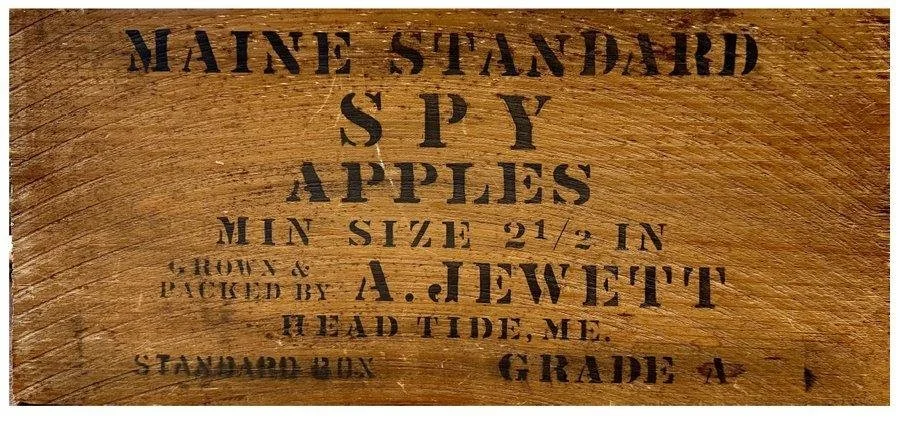
A. Jewett crate end, c. 1930s. Stamped "MAINE STANDARD / SPY / APPLES / MIN SIZE 2½ IN / GROWN & PACKED BY A. JEWETT / HEAD TIDE, ME. / STANDARD BOX / GRADE A." A single object that records, in stamped wood, the variety, the size standard, the formal grade, and the regulated container behind every barrel that left Head Tide. From the Jewett Store collection.
[We read the "A. Jewett" on the stamp as Alice B. Jewett, the same shipper named on the 1929 WW&F bill of lading. The container and grade language reflects the standards of the period. Apples of this era moved in two legally defined containers: the barrel, a federally standardized unit of about 7,056 cubic inches (U.S. Standard Barrel Act of 1912), and the bushel box, which Maine law fixed at 17 × 13 × 11 inches — 2,431 cubic inches — and defined as a lawful bushel. As for the grade language, Todd Little-Siebold, director of the Maine Apple Lab at College of the Atlantic, explains that "Maine Standard" meant the fruit met the state's packing and size standards — rules Maine developed and enforced, with the State as regulator, to guarantee consistent quality after its apples had earned a reputation for mixed quality in out-of-state markets. The minimum size behind a "Grade A" Northern Spy was likely 2½ inches, matching the stamp on this crate; Maine's official grade names followed the U.S. (USDA) grades introduced in 1923.]
Paper labels tell the same story on a smaller scale. A printed Ledge Hill Farm label from our collection advertises "Maine Northern Spy Apples, Grade A, Min. Size 2½ in., Min. Volume 1 Bushel, Grown and Packed by Victor Gregoire, Head Tide, Maine." The parallels to the A. Jewett crate stamp are striking: same variety, same minimum size, same Grade A designation — evidence that Head Tide growers were packing to a shared standard, whether they were shipping two hundred barrels or a single bushel.
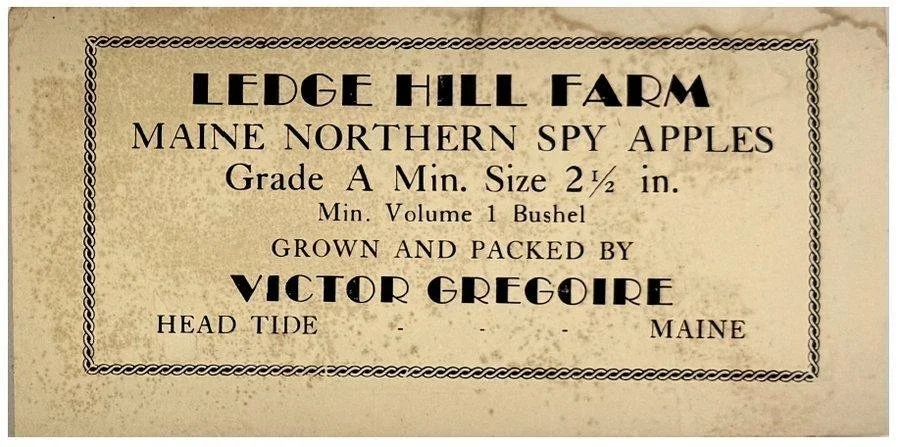
Ledge Hill Farm bushel label. "Maine Northern Spy Apples, Grade A, Min. Size 2½ in., Min. Volume 1 Bushel, Grown and Packed by Victor Gregoire, Head Tide, Maine." From the Jewett Store collection.
[Victor Gregoire was Alice B. Jewett's husband and Joan Gregoire's father; the Ledge Hill Farm operation was the family's complement to the Head Tide Store's larger-scale apple shipping business.]
Before any of that paperwork came the picking itself. Joan Gregoire's photograph shows cooper-made splint baskets of the kind local growers used for orchard picking and short-haul sales — the first container an apple entered before it was graded, weighed, and repacked for shipment. Several baskets of this type survive in the Head Tide Store collection. A photo of John Allen Jewett (1840–1916) shows him standing in an orchard of apple-laden trees holding a picking basket of similar splint construction but distinct in one detail: its handle is a wire bail rather than the splint loops on the stacked baskets — evidence of more than one picking-basket variant in use in Head Tide orchards.
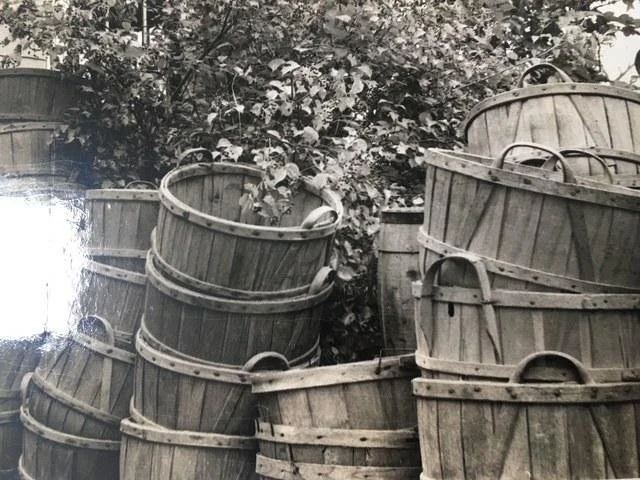
Cooper-made splint baskets. The first container an apple entered before it was graded, weighed, and repacked for shipment. Splint construction throughout — vertical staves, horizontal hoops, and looped side handles are all bent strips of the same flexible wood (likely steamed and shaped while green) — was the standard Maine orchard picking basket in the early twentieth century. Several baskets of this type are in the Head Tide Store collection and are available for incorporation into the physical display. Photograph courtesy of Joan Gregoire.
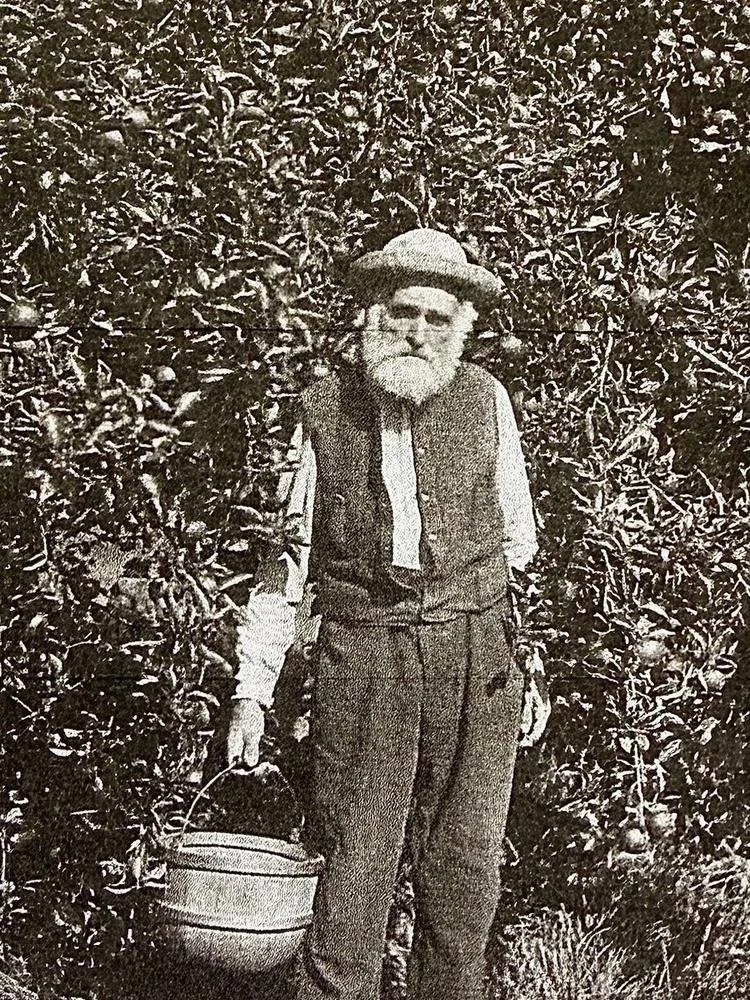
John Allen Jewett (1840–1916) in the orchard. J. Allen Jewett — postmaster at Head Tide, and the patriarch whose store the apples passed through on their way to market — standing among his fruit-laden trees, holding a picking basket. The basket itself appears to be of the same splint construction as those above (vertical staves and what look like wooden hoops), but its handle is of a different type: a single arched wire bail with a turned wooden grip at its top, rather than the looped splint handles on the stacked baskets in Joan Gregoire's photograph. From the Jewett Store collection. (Source is a scan of a photocopy; a higher-quality scan of the original photograph will replace this version when one becomes available.)
The apple house, and the night it burned. All of it — the picking, grading, barreling, and loading — converged on the Jewett Brothers' apple storage house on the west bank of the Sheepscot, where barrels waited, heated against the cold, for the train. On the bitterly cold, windy evening of Monday, November 17, 1924, fire broke out in that storage house. Glen Jewett had crossed the bridge to the store for more kerosene for the heaters; by the time he came back in sight of it, flames were breaking through the roof and walls. Driven by a high wind, the fire took the storage house and some 200 to 300 barrels of apples, then the saw mill and lumber yard, the family's house, and the garage. Fire fighters came from Wiscasset and Damariscotta; the bridge caught but did not burn, the wind shifted, and the flames never crossed the river. The Jewetts carried no insurance, and the loss was put at $20,000 to $30,000 — on the order of $375,000 to $560,000 in today's dollars. Most of that season's crop, though — thousands of barrels — had already gone to market before the fire. And the apple trade outlasted the night: the bills of lading and consignment statements shown on this panel all date from after 1924, the business carrying on under the Estate of Glen A. Jewett.
LISTEN — ORAL HISTORY, 1978
Nina Cheney — the 1924 fire
NA1200 Nina Cheney, interviewed by Michael Chaney, 20 June 1978. Special Collections, Raymond H. Fogler Library, University of Maine, "MF030 Lincoln County Project / Leighton Photo Collection." Northeast Archives of Folklore and Oral History, University of Maine.
[The fire is reported in the Lincoln County News of November 20, 1924 ("Conflagration Sweeps Head Tide") and recalled in a contemporary letter from Lydia Keene Jewett to her daughter Alice and in Nina Cheney's 1978 oral history. The date, loss estimate, responding fire companies, the "thousands of barrels… most already shipped," and the loss of the village's private electric plant are from the newspaper; the kerosene errand and the family's account of the night are from the letter. That the business continued is documented by the post-1924 shipping records shown above. Present-day dollar equivalents are approximate, based on the U.S. Bureau of Labor Statistics Consumer Price Index; conversions across a century are inexact and meant only to convey scale.]
Sources: WW&F Railroad bill of lading, November 1, 1929 (Estate of Glen A. Jewett, Alice B. Jewett, 175 barrels of apples to Hannaford Bros., Portland, with delivery to N.E. Cold Storage); Maine Central Railroad bill of lading, 21 November 1930 (Lon Jewett, carload of bulk apples, 43,000 lbs, to Hannaford Bros. Kennebec Street Cider Mill, Portland); A. Jewett crate end and Ledge Hill Farm / Victor Gregoire bushel label, Jewett Store collection; John Allen Jewett orchard photograph (scan of a photocopy; a higher-quality scan of the original is sought) and cooper-made splint basket photograph (courtesy Joan Gregoire); WW&F operating dates per Wiscasset, Waterville & Farmington Railway Museum. The November 1924 fire: Lincoln County News, "Conflagration Sweeps Head Tide," November 20, 1924, p.1; letter, Lydia Keene Jewett to Alice B. Jewett, November 1924; Nina Cheney oral-history interview, June 20, 1978, NAFOH accession 1200.1.