APPLES IN HEAD TIDE · PANEL VII
Status note: The Apples in Head Tide exhibit's physical installation at the Head Tide Store, 45 Head Tide Road, Alna, is in preparation. Opening date to be announced — these pages are live in advance of the physical exhibit and will remain as its permanent online companion.
Apples Along the Way: A Living Legacy
Along the old narrow-gauge right-of-way, apple trees still grow where no orchard was ever planted.
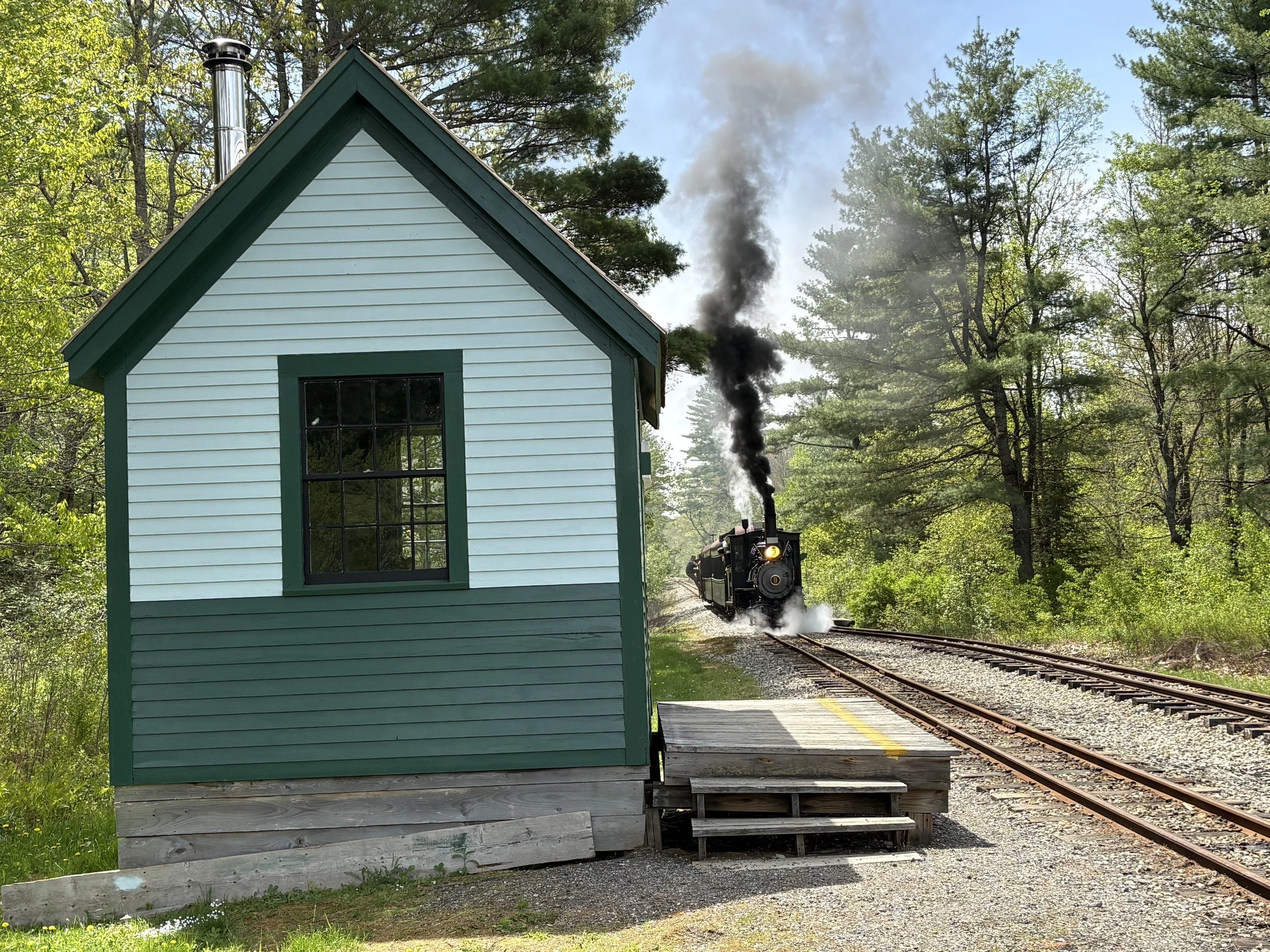
The WW&F's 1891 No. 9 approaches the Alna Center station today. Photograph by Ed Pentaleri, May 2026.
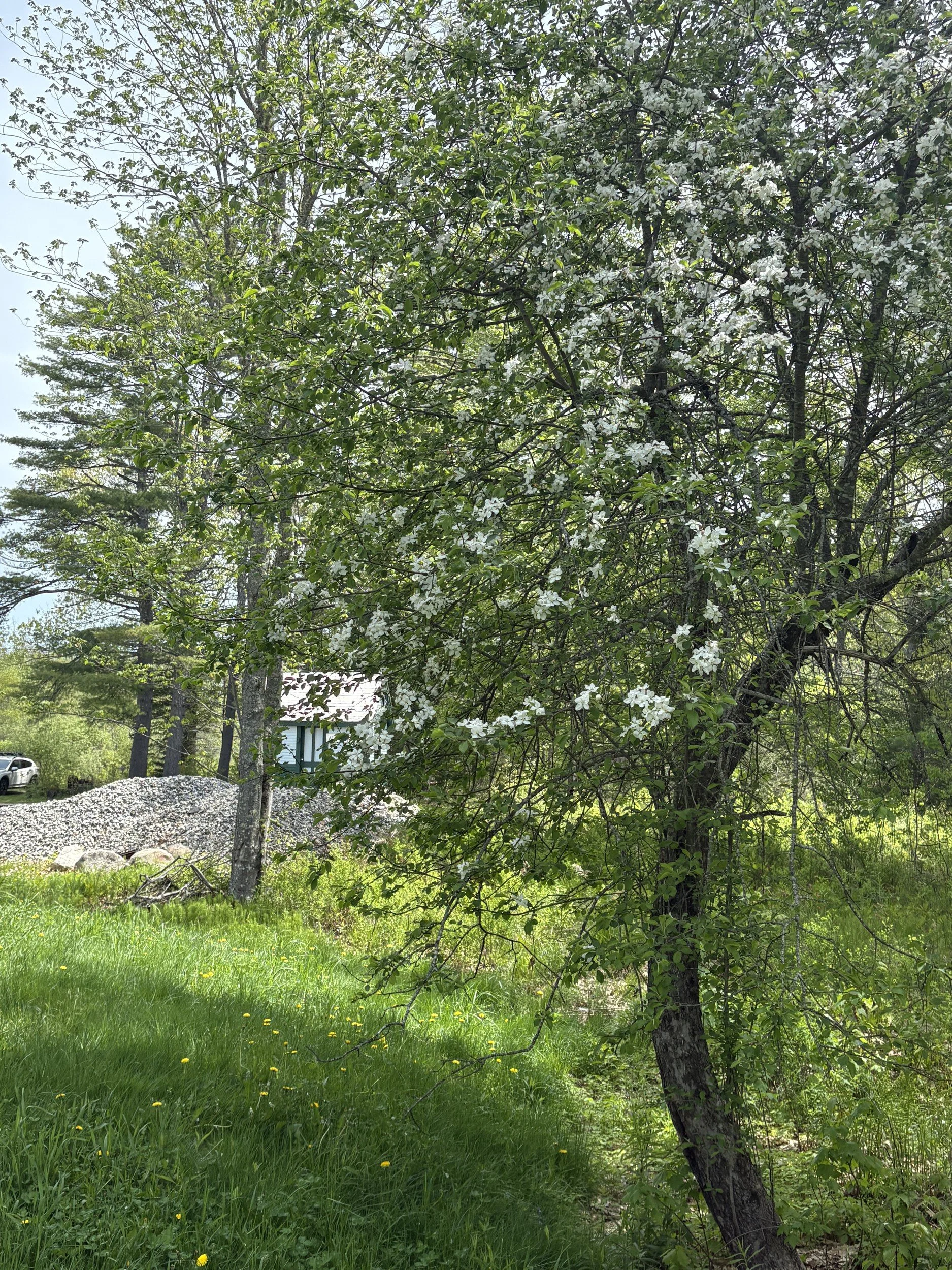
An apple tree stands along the railway right-of-way with the Alna Center station behind it. Photograph by Ed Pentaleri, May 2026.
The apples that left Head Tide on the narrow-gauge WW&F never quite all departed. The fruit that growers couldn't sell, that workers ate on the line, that passengers tossed from windows — those cores carried seeds, and seeds carry trees. A century later, the trees still bear fruit along the old right-of-way.
The story is local lore with attribution. In about 1996, Bruce Wilson walked the line with Harry Percival, the founder of today's Wiscasset, Waterville & Farmington Railway Museum. Pointing out an apple tree growing in what had been the railway's path, Percival told Bruce that the trees along the line "likely grew from cores tossed from train windows." Mike Fox — president and a member of the board of directors of the WW&F Railway Museum, who knew the same trees from his own walks — told the same story in his own words.
[Harry Percival (1930–2001) acquired the abandoned WW&F right-of-way in 1989 and built his retirement home at Sheepscot station; the WW&F Railway Museum is the institutional descendant of his early restoration work. The "cores tossed from train windows" remark was related to Ed Pentaleri by Bruce Wilson on May 17, 2026; Mike Fox's parallel observation came through the same channel. Neither attribution is documented in a published source.]
The tree in the photographs at the top of this panel grows beside the Alna Center pavilion — one of the trees Mike Fox specifically remembered. The hero pair came from a single visit Ed Pentaleri made to the line after speaking with both Bruce and Mike: a late-morning visit in May 2026 timed, by happy coincidence, to a brief window when the tree was at the peak of its bloom and No. 9 happened to be passing through the same field of view.
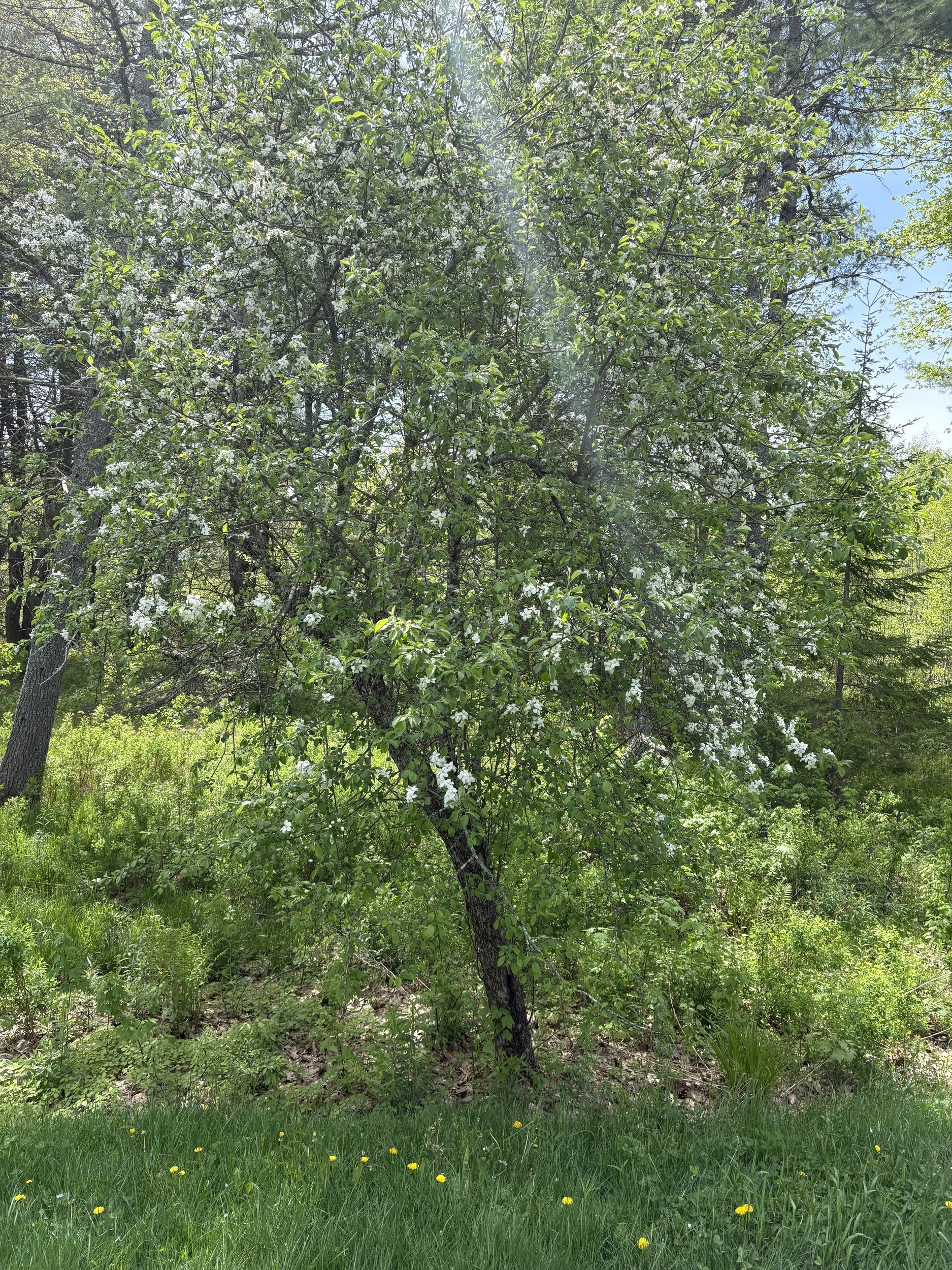
A closer look at the tree by the pavilion. Photograph by Ed Pentaleri, May 2026.
The contemporary thread runs through the same station. In October 2017, Maine apple historian John Bunker — proprietor of Out on a Limb Apples in Palermo, founder of Fedco Trees, and the most prominent identifier and preserver of Maine's heritage apple varieties — gave a talk at Alna Center on the apples of Maine. Attendees rode up from Sheepscot station on the museum's restored train to hear it. The talk seeded the idea for this exhibit: a closing loop in which the railway that had carried apples out to the world had inadvertently planted them back along its own line, and the apple historian who could speak to those varieties had come back to talk about them at one of the railway's restored stations.
Bunker has spent more than half a century traversing Maine in search of surviving heritage trees, identifying old varieties from cuttings and preserving them by grafting twigs onto rootstock at his Out on a Limb nursery. His Palermo orchards today are a living library of hundreds of rare and historic apple cultivars, many of them named in old fair records or pomological reports that had lacked surviving specimens until Bunker found them. The trees along the WW&F right-of-way are not catalogued. They may be heirloom varieties long lost to the commercial trade; they may be the wild crosses that result when a seed sprouts unattended. Either way, they are living artifacts of the apple-shipping years documented in this exhibit — the orchards' afterimage, persistent and quietly producing.
Only remnants of the orchards on the hillsides above Head Tide remain. The narrow-gauge line that carried their fruit closed in 1933. But the seeds that left those orchards on the rails — eaten on the line, tossed from windows — found their way into the disturbed soil alongside the tracks, and a generation later they grew into trees. The trees are still there. Apples in Head Tide opens with the orchards that were lost and closes with the orchards that planted themselves.
If you walk the line and find a fruit-bearing tree along the right-of-way, John Bunker would like to hear about it. He can be reached through Out on a Limb Apples in Palermo.
[The "cores tossed from train windows" mechanism is local lore. It is also pomologically plausible: apple seeds do not breed true (a seed from any apple sprouts into a tree whose fruit may bear no resemblance to its parent), but they germinate readily in disturbed soil, and a discarded core left in the right conditions can produce a tree. We make no claim that any specific tree along the WW&F right-of-way originated this way.]
[Bunker's lifetime work is summarized in numerous public sources, including profiles by Down East magazine and the corporate history of Fedco Trees, the mail-order nursery he founded in 1984 as a division of the Fedco Seeds cooperative. His nursery at Out on a Limb in Palermo is open to visitors during scheduled events.]
Sources: Photographs by Ed Pentaleri, May 2026 (WW&F No. 9 approaching the Alna Center station; apple tree on the right-of-way with the station behind; closer study of the tree by the pavilion). Harry Percival biographical detail and "cores tossed from train windows" attribution per Bruce Wilson's correspondence with Ed Pentaleri, May 17, 2026. Mike Fox parallel observation per Bruce Wilson; the tree in the panel's hero pair specifically remembered by Mike Fox. John Bunker, talk at Alna Center, October 2017. John Bunker, Out on a Limb Apples, Palermo, Maine (outonalimbapples.com). Fedco Trees corporate history (fedcoseeds.com).